Hangfire UI-Driven Schedule Management - Generic Structure Implementation
Author(s)
- Yeasa Mondal
- Dipak Mourya
Submission Date
05/03/2026
Version History
| Version | Date | Changes | Author |
|---|---|---|---|
| 1.0 | 2026-03-05 | Generic Structure Approach | Yeasa Mondal, Dipak Mourya |
Objective
This document outlines the implementation plan for enhancing the existing Hangfire schedule management system with a single, unified JSON structure for all schedule types. The feature standardizes schedule configuration to make it easier for UI development and consistent across all schedule modes.
Scope
This implementation includes:
- Single unified JSON structure for all schedule modes (interval, hourly, daily, weekly, yearly, custom)
- Generic field set: mode, minute, hour, dayOfWeek, dayOfMonth, month
- Mode-based validation with automatic cron generation
Related Features
- Feature 1: UI-driven schedule configuration management
- Feature 2: Generic schedule structure for all schedule types
- Feature 3: Trigger button for any scheduler manually
Technical Approach
Current State
- ✅ Hangfire configured in IntegrationService with recurring jobs
- ✅ Database table
tblintegration_job_configexists withschedule_config JSONBandcron_schedule VARCHAR(100) - ✅ Jobs execute based on cron_schedule from database
Target State
- 🎯 Single unified JSON structure for all schedule modes
- 🎯 Generic field set with mode-based validation
- 🎯 Automatic cron generation from generic structure
- 🎯 APIs to perform following tasks
- 🎯 Simplified UI development with consistent 6-field interface
Generic Schedule Structure
All schedule modes use this unified JSON format:
{
  "mode": "string (required)",
  "minute": "int or null",
  "hour": "int or null",
  "dayOfWeek": "int or null",
  "dayOfMonth": "int or null",
  "month": "int or null",
  "description": "string"
}
Field Usage Matrix
| Mode | minute | hour | dayOfWeek | dayOfMonth | month |
|---|---|---|---|---|---|
| interval | ✅ Value | ❌ null | ❌ null | ❌ null | ❌ null |
| hourly | ✅ 0-59 | ❌ null | ❌ null | ❌ null | ❌ null |
| daily | ✅ 0-59 | ✅ 0-23 | ❌ null | ❌ null | ❌ null |
| weekly | ✅ 0-59 | ✅ 0-23 | ✅ 0-6 | ❌ null | ❌ null |
| yearly | ✅ 0-59 | ✅ 0-23 | ❌ null | ✅ 1-31 | ✅ 1-12 |
| custom | ✅ 0-59 | ✅ 0-23 | ⚠️ XOR | ⚠️ XOR | ⚠️ opt |
Design Specifications
Below, you can see the provided UI design showcasing these changes.
- UI/UX Design:
The first image displays the table listing all scheduled cron jobs.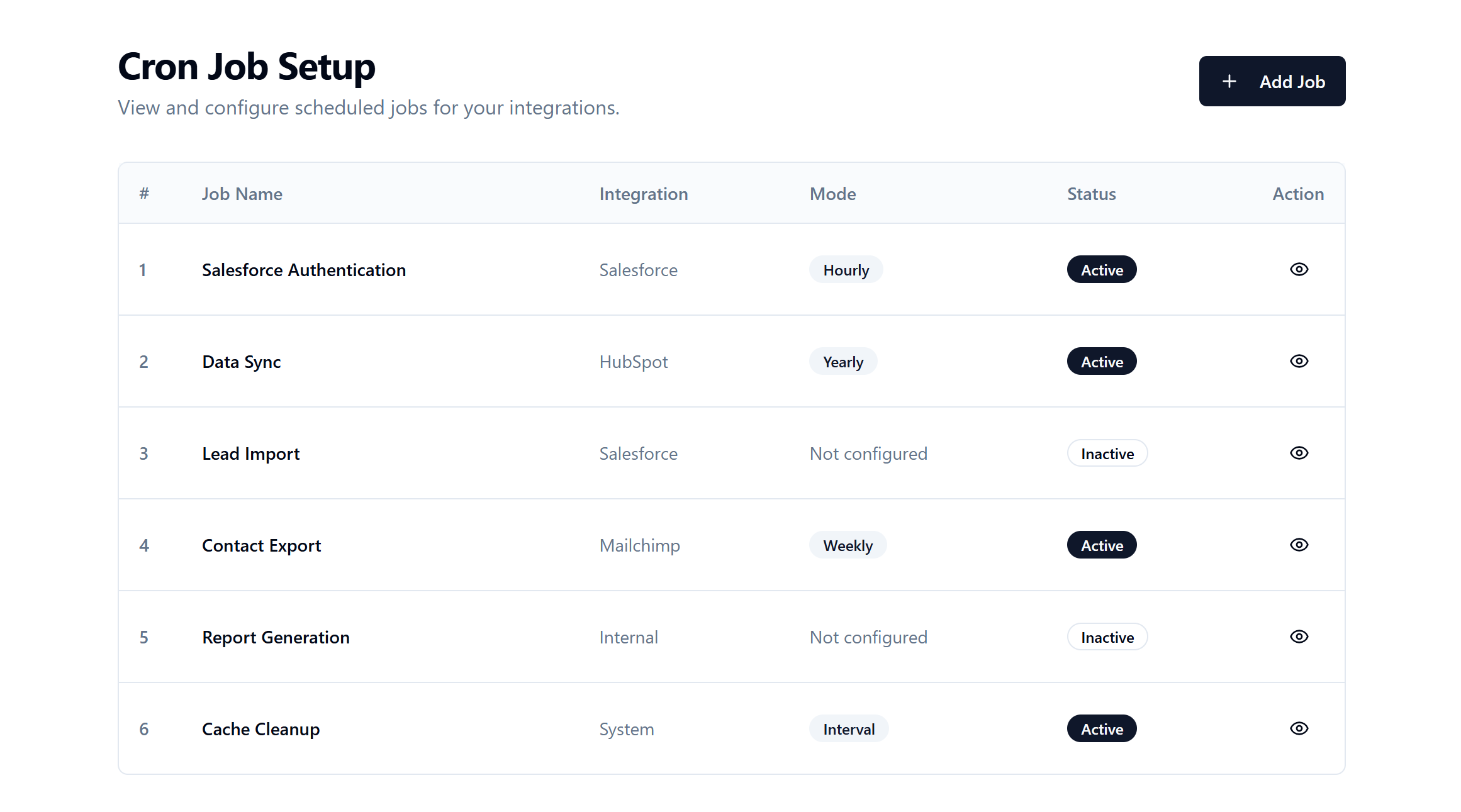 The second image shows the sidebar form that opens from the right side when the user clicks the View (eye) button to configure or view the cron job settings.
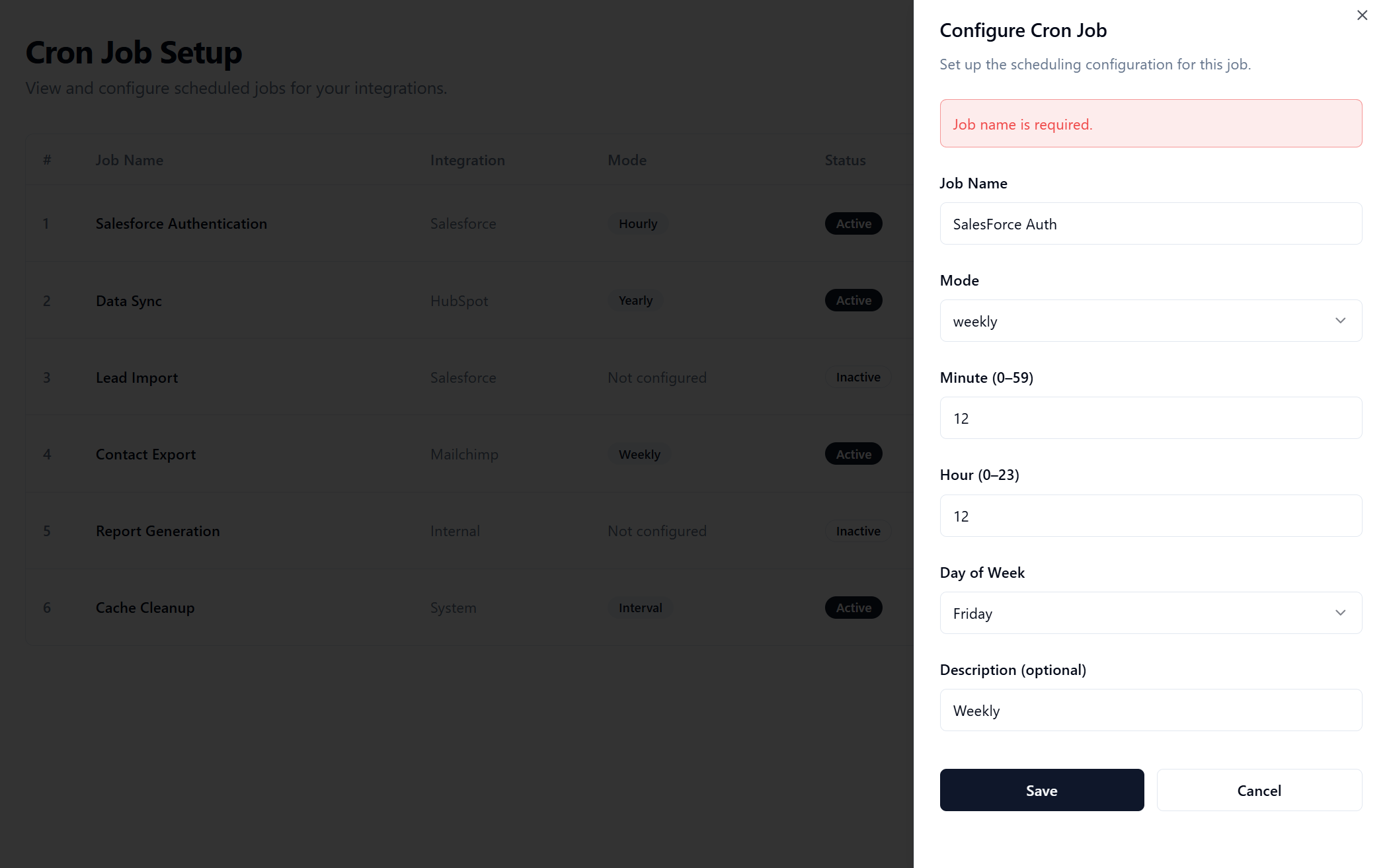
Click here to view the live demo page:
https://muddvision.lovable.app/
Development Tasks & Estimates
| No | TaskName | Estimate (Hours) | Dependencies | Notes |
|---|---|---|---|---|
| 1 | Create GenericScheduleConfig DTO in ContractLibrary | 2 hours | No dependency | Includes all mode validations |
| 2 | Implement ToCronExpression() for all 6 modes | 3 hours | Task 1 | Interval, hourly, daily, weekly, yearly, custom |
| 3 | Update UpsertJobConfigRequest/Response DTOs | 1 hour | Task 1 | Replace old config with generic |
| 4 | Update JobConfigDAL serialization logic | 2 hours | Task 3 | Include backward compatibility |
| 5 | Add GetDescription() helper method | 1 hour | Task 1 | Human-readable schedule descriptions |
| 6 | Create unit tests for all schedule modes | 4 hours | Task 2 | Test validation and cron generation |
| 7 | Create integration tests for API flow | 3 hours | Task 4 | End-to-end testing |
| 8 | Document frontend integration guidelines | 1 hour | Task 3 | UI form structure and field rules |
| 9 | Implement migration script for existing configs | 2 hours | Task 4 | Convert old format to generic |
| 10 | Code review and documentation | 1 hour | All tasks | Final review and API docs |
| 11 | Set up the Scheduler Frequency Cron Job page and configure the route for the Admin scope | 1 hour | No dependency | Frontend page and routing setup |
| 12 | Create a table to display cron job configuration details | 2 hours | Task 11 | Table UI for cron jobs |
| 13 | Integrate the API to retrieve cron job configuration and job details | 1 hour | Task 12 | API integration for table data |
| 14 | Create a mock API for the cron job configuration data used in the table | 1 hour | Task 12 | Mock data for development/testing |
| 15 | Develop a modal where users can update cron job settings based on the selected mode and handle all possible cases | 6 hours | Task 12, Task 13 | Modal UI and logic for all schedule modes |
| 16 | Test all scenarios thoroughly to ensure proper functionality | 2 hours | Task 15 | Frontend testing for all cases |
| Total | 34 hours | ~4 days |
Testing & Validation
Unit Test Coverage
- ✅ Interval mode: minute-based and hour-based intervals with validation
- ✅ Hourly mode: minute validation (0-59)
- ✅ Daily mode: minute and hour validation
- ✅ Weekly mode: dayOfWeek validation (0-6, Sunday=0)
- ✅ Yearly mode: full date/time validation
- ✅ Custom mode: XOR validation for dayOfWeek/dayOfMonth
Integration Tests
- POST schedule with each mode and verify cron generation
- GET schedule and verify all fields match
- Update schedule and verify changes propagate
- Test backward compatibility with old format
- Verify job execution with generated cron expressions
Sample Test Scenarios
Interval Mode:
// Every 15 minutes
{"mode":"interval","minute":15,"hour":null,"dayOfWeek":null,"dayOfMonth":null,"month":null}
// Expected cron: */15 * * * *
Weekly Mode:
// Every Monday at 9:00 AM
{"mode":"weekly","minute":0,"hour":9,"dayOfWeek":1,"dayOfMonth":null,"month":null}
// Expected cron: 0 9 * * 1
Custom Mode:
// First day of every month at 9:00 AM
{"mode":"custom","minute":0,"hour":9,"dayOfWeek":null,"dayOfMonth":1,"month":null}
// Expected cron: 0 9 1 * *
Risks & Mitigations
| Risk | Impact | Mitigation |
|---|---|---|
| Breaking changes for existing schedules | High | Implement backward compatibility layer in DAL |
| Invalid cron expressions generated | High | Comprehensive unit tests for all mode combinations |
| UI/API contract mismatch | Medium | Clear documentation and integration tests |
| Migration script edge cases | Medium | Thorough testing with production-like data |
| Performance impact of JSON validation | Low | Optimize validation logic, use caching if needed |
Conclusion
The Generic Structure Implementation provides a unified, maintainable approach to Hangfire schedule management. By standardizing on a single JSON structure with mode-based validation, we achieve:
- Simplified Backend: Single DTO class instead of 6 derived classes
- Easier Frontend Development: Always work with same 6 fields
- Consistent Database Schema: No polymorphic type discriminators needed
- Better Testability: Predictable validation rules and test patterns
Status: Ready for Implementation
Document Version: 1.0
Expected Completion: ~4 days (34 hours)