Architecture Document
1. Introduction
This document provides a comprehensive overview of the technical architecture for the MyBestDealNow.com platform. The aim is to illustrate how various components are designed to interact, ensuring a scalable, reliable, secure, and high-performing system capable of supporting our innovative reverse auction model for car buying and selling. This architecture is foundational to delivering the robust features outlined in our Software Requirements Specification (SRS).
2. System Architecture Diagram
Below is the high-level system architecture diagram for MyBestDealNow.com:
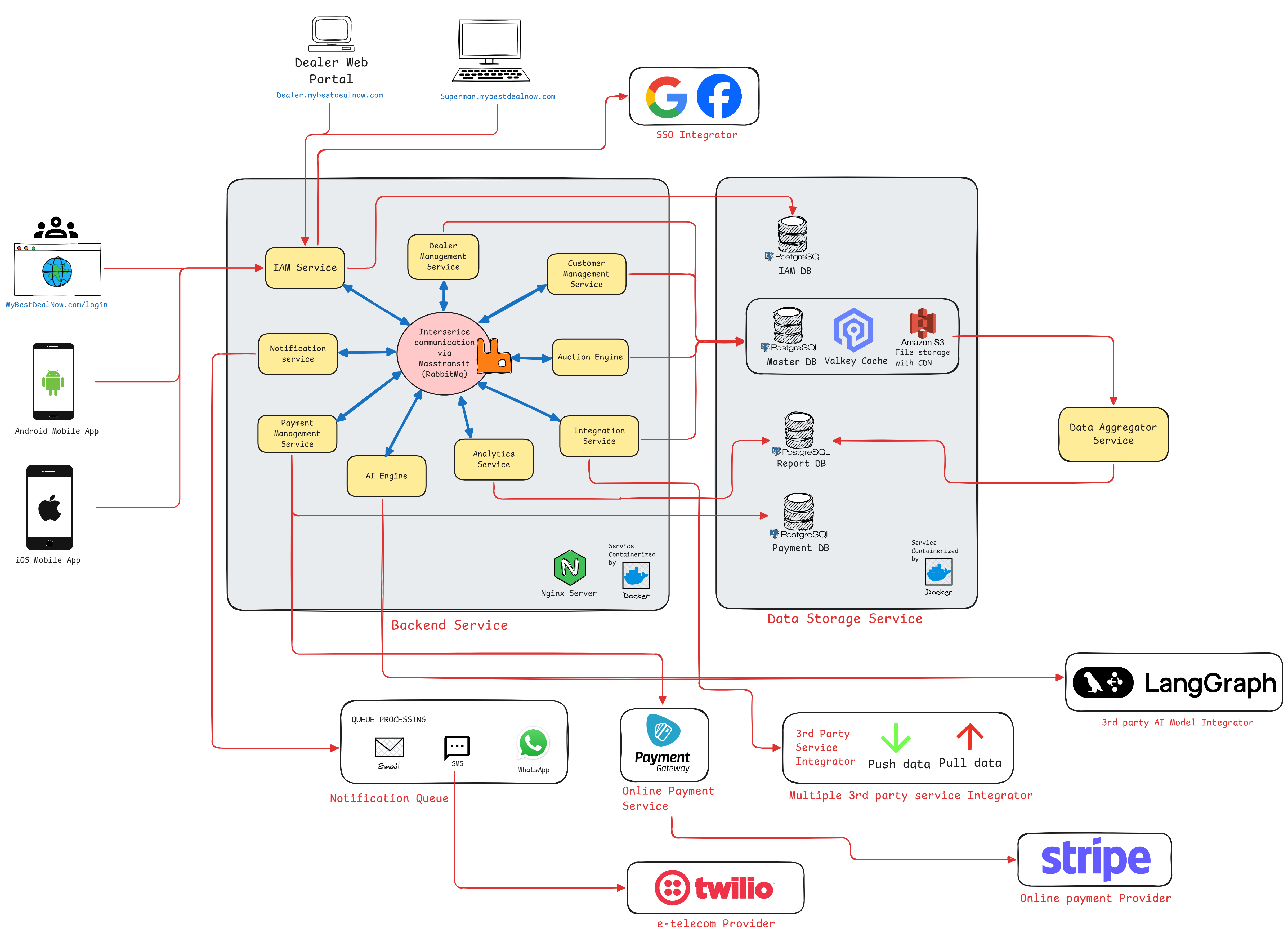
3. Architecture Overview and Component Breakdown
The MyBestDealNow.com architecture is designed as a microservices-based system, promoting modularity, scalability, and independent deployment. It can be broadly categorized into the following layers:
3.1. User Access Layer (Client-Side Interactions)
This layer represents the various interfaces through which end-users (buyers and dealers) interact with the MyBestDealNow.com platform.
-
Buyer Web Portal: The primary web application accessible via desktop and tablet browsers for car buyers. This provides the interface for vehicle specification, auction browsing, bid comparison, and communication.
-
Dealer Web Portal: A dedicated web application for dealerships, providing tools for account management, viewing buyer requests, submitting bids, and accessing analytics.
-
iOS Mobile App: A native application for Apple devices (iPhones, iPads) offering a rich, optimized mobile experience for both buyers and dealers.
-
Android Mobile App: A native application for Android devices (smartphones, tablets) providing similar functionality and user experience to the iOS app.
All web portal traffic is routed through Nginx, which acts as a reverse proxy and load balancer, efficiently distributing requests to the backend services.
3.2. Backend Services Layer (Core Logic and Processing)
This layer comprises a suite of independent microservices that handle the core business logic and processing for the platform. These services are containerized using Docker for consistent deployment and scalability.
-
IAM (Identity & Access Management) Service:
- Purpose: Manages all user authentication (login, signup, SSO via Google Integrator), authorization, and user profile data for both buyers and dealers.
- Key Functionality: User registration, login, password management, session management, and role-based access control.
-
Notification Service:
- Purpose: Responsible for generating and delivering real-time notifications to users across various channels.
- Key Functionality: Sends alerts for new bids, outbid notifications, chat messages, auction updates, and AI recommendations via in-app notifications, push notifications (FCM for Android, APNs for iOS), email, and SMS. Utilizes a Notification Queue for asynchronous message delivery.
-
Payment Management Service:
- Purpose: Handles all payment-related operations for the platform.
- Key Functionality: Manages dealership subscriptions, processes billing, and potentially handles commission fees from successful transactions (future phase). Integrates with external Online Payment Providers like Stripe.
-
Analytics Service:
- Purpose: Collects, processes, and stores data related to platform usage, user activity, auction performance, and other key metrics.
- Key Functionality: Provides insights and generates reports for platform administrators and dealerships (e.g., bid success rates, win ratios).
-
AI Insights Service:
- Purpose: The central hub for all Artificial Intelligence capabilities within the platform.
- Key Functionality: Generates AI-driven recommendations for buyers (AI Concierge), provides optimal bidding suggestions for dealers, and performs lead scoring. Integrates with external 3rd Party AI Model Integrators (e.g., LangGraph) to leverage advanced AI models.
-
Auction Engine:
- Purpose: The core operational module for the reverse auction process.
- Key Functionality: Manages real-time bidding, validates bid amounts, enforces auction rules, tracks auction timers, and determines auction outcomes.
-
Dealer Management Service:
- Purpose: Dedicated to managing dealership-specific operations and data.
- Key Functionality: Handles dealership profile management, inventory linking (initially manual, with future API integration to Dealer Management Systems), and specific settings relevant to dealer interactions on the platform.
-
Customer Management Service:
- Purpose: Manages broader customer relationship functions and comprehensive user profiles beyond basic authentication.
- Key Functionality: May include customer support interactions, feedback management, and detailed user activity tracking.
-
Inter-service Communication (RabbitMQ):
- Purpose: Facilitates robust, asynchronous, and reliable communication between all the individual microservices within the Backend Services Layer.
- Key Technology: RabbitMQ, a widely used message broker, ensures that services can communicate efficiently without direct dependencies, improving system resilience and scalability.
3.3. Data Storage Layer
This layer is responsible for the persistent storage and retrieval of all platform data, utilizing a relational database approach for optimal performance and flexibility.
-
PostgreSQL Databases: A robust, open-source relational database management system, chosen for its reliability, data integrity, and extensibility.
- IAM DB: Specifically for Identity and Access Management data (user credentials, roles, etc.).
- Master DB: The primary transactional database for the application, storing core data related to auctions, bids, buyer requests, and other critical operational information. It is complemented by a Valkey Cache (an in-memory data structure store) for lightning-fast retrieval of frequently accessed data, significantly boosting performance.
- Report DB: Optimized for analytical queries and reporting. It stores aggregated and transformed data, making it efficient for generating insights without impacting the performance of the Master DB.
- Payment DB: Stores all payment-specific records and transactional data, ensuring consistency and integrity within the relational database structure.
-
Data Aggregator Service:
- Purpose: This dedicated service is responsible for consolidating and transforming data from the PostgreSQL Master DB into the PostgreSQL Report DB.
- Key Functionality: It processes raw transactional data from the Master DB, aggregates it, and structures it for efficient analytical querying in the Report DB.
3.4. External Integrations
This layer depicts the connections to third-party services that extend the platform's capabilities.
-
Google Integrator (SSO): Enables Single Sign-On (SSO) functionality, allowing users to register and log in using their Google accounts for a streamlined onboarding experience.
-
Online Payment Provider (Stripe): Integrates with a secure payment gateway (e.g., Stripe) for processing financial transactions, such as dealership subscriptions.
-
E-telecom Provider (Twilio): Utilized for sending SMS notifications and potentially other telecommunication services.
-
3rd Party AI Model Integrator (LangGraph): A crucial component that allows the AI Insights Service to connect with and leverage various external AI models and services (e.g., for advanced NLP, predictive analytics, etc.).
-
Multiple 3rd Party Service Integrator: A generic component representing the platform's capability to integrate with other external systems as needed, such as Dealer Management Systems (DMS), Customer Relationship Management (CRM) systems, or financing partners in future development phases.
4. Conclusion
This architecture provides a robust, scalable, and secure foundation for MyBestDealNow.com. The microservices approach, combined with a unified relational data storage strategy, asynchronous communication via RabbitMQ, and strategic AI integrations, ensures that the platform can deliver a highly responsive and intelligent experience while being adaptable to future growth and evolving market demands.